


The League of Women Voters of Ohio is a nonpartisan, grassroots
organization working to protect and expand voting rights and ensure everyone is represented in our democracy.
We empower voters and defend democracy through advocacy, education, and litigation, at the local, state, and national levels.
2026 IS A MIDTERM ELECTION YEAR |
HERE'S WHAT THAT MEANS & HOW TO BE READY
What are midterm elections?
Mid-term elections are elections that are held half-way through a President’s 4-year term. This election does not include voting for the Presidency, but does include elections for all members of the US House of Representatives, about 1/3rd of the US Senate, and many governors and members of state legislatures.
What's on the ballot in Ohio?
This year, Ohioans will be voting on candidates seeking office for positions at the federal, state, and county level. In addition to the US House and Senate seats, Statehouse seats, and governorship mentioned above, we're also electing all our state executive seats, 2 Ohio Supreme Court Justices, and important leaders at the county and municipal level. VOTE411 will have your personalized ballot, along with your district information, polling place, and updated Ohio election rules, so be sure to check there when you're getting ready to vote
Federal offices
-
1 US Senate seat
-
All 15 US House seats
Ohio state executive offices
-
Ohio Governor
-
Ohio Attorney General
-
Ohio Secretary of State
-
Ohio Treasurer
-
Ohio Auditor
-
2 of 7 Ohio Supreme Court Justices
County/Municipal offices
-
County Commissioner/Executive
-
County Auditor
-
Municipal Judges
State & Local Issues
-
Statewide Issue 3: Proposed Constitutional Amendment to make the existing state law requiring voter ID constitutionally required (see more here)
-
Local levies, bonds, and issues: Many Ohio communities will be voting on levies that will decide if local services will get new or continued funding through local property or income tax. Schools are the most common type of levy; public safety levies that fund policy and fire departments are also common, as are levies that fund libraries, social services, and parks.
When is the deadline to register to vote for the midterm election?
October 5 is the last day to register to vote or to update your voter registration. You can do that here.
When does early voting start for the midterm elections?
Early voting starts on October 6. Eligible voters can vote at their county Board of Elections during scheduled voting hours or vote by mail with an absentee ballot. See the early in-person schedule here; county Boards of Elections begin mailing absentee ballots on October 6 to eligible voters who have sent their absentee ballot request.
When is Election Day?
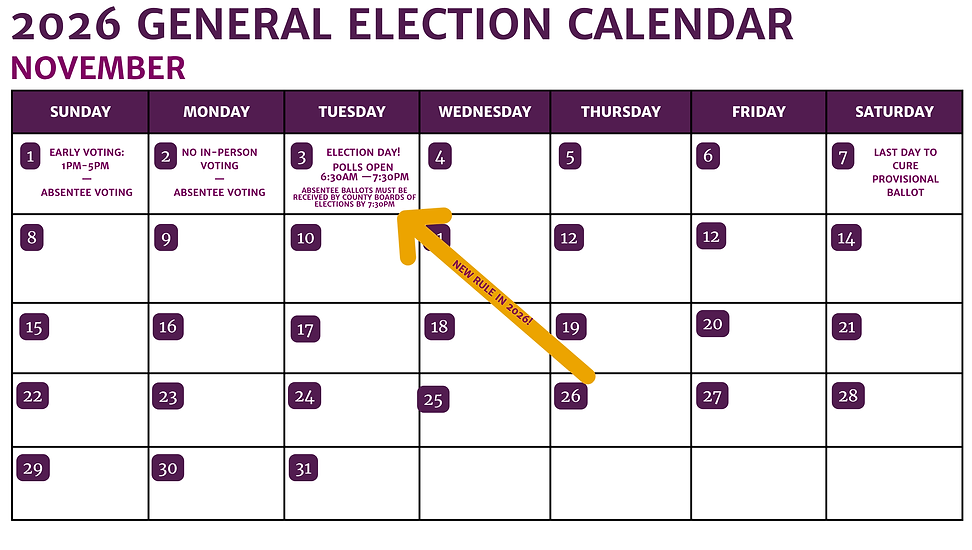
Election Day is November 3rd, with polls open from 6:30 a.m. to 7:30 p.m.
(continue reading for more on what you need to be voting ready in Ohio for 2026)
IMPORTANT: OHIO'S ABSENTEE BALLOT DEADLINE HAS CHANGED
All absentee ballots must be received by the voter's county Board of Elections by 7:30pm on Election Day.
The post-election acceptance period for ballots with USPS postmarks before Election Day has been eliminated with a new law, signed by Governor DeWine in December 2025; read more here.
Absentee ballots received after polls have closed on Election Day will not be accepted.

NELSONVILLE REDISTRICTING |
2024 - 2026
What's happening?
In 2024, the residents of Nelsonville voted to return to a general statutory form of government. That change requires the city to be divided into four council wards. In a commitment to transparency and civic engagement, the City of Nelsonville requested that the League of Women Voters of Ohio and the League of Women Voters of Athens County lead a public process to design a ward map based on community input.
Throughout 2025 and into 2026, we have supported this Ohio community with the following goals:
-
Establish an open and transparent process that educates, informs, and includes the citizens of Nelsonville in the creation of a city council ward map.
-
Construct and complete a ward map proposal that complies with all applicable federal and state laws concerning municipal districting, specifically Section 731.06 of the Ohio Revised Code.
-
Present a city ward map proposal to the Nelsonville City Council for a vote of approval.
-
Demonstrate and document a process that can serve as an example and be used as a guide for other municipalities that are preparing to draw or redraw voting districts.
What Makes a Fair Ward Map?
The ward map must follow guidelines laid out in the Ohio Revised Code Section 731.06, which requires that:
“All wards shall be bounded, as far as practicable, by county lines, streets, alleys, lot lines, avenues, public grounds, canals, watercourses, municipal corporation lines, center lines of platted streets, or railroads, and shall be composed of adjacent and compact territory, and substantially equal in population.” – 731.06(D)
FEDERAL LEGISLATION |
STOP THE SAVE AMERICA ACT
What is the SAVE America Act?
The SAVE (Safeguard American Voter Eligibility) America Act is a bill in Congress that would require every American to provide documentary proof of citizenship – in person – to register to vote in federal elections, or to change or update their voter registration to vote in federal elections. This bill would also require new photo ID requirements for federal elections, and requires states to turn their voter rolls over to the Department of Homeland Security.
This bill passed in the US House February 11, 2026, and will now go to Committee in the US Senate. You can read the House bill here.
Are the SAVE Act and the SAVE America Act the same?
No. The SAVE America Act is worse.
The SAVE Act, a bill that was passed by the US House in 2025, and a similar version before that in 2024, focused on new, strict requirements for voter registration (more below).
The SAVE America Act, introduced in 2026, includes the same strict voter registration restrictions as previous versions of the SAVE Act but adds:
-
photo ID requirements for in-person voting: voters would be required to provide government-issued photo ID to vote in person; specifically U.S. passports, driver's licenses, state IDs, military IDs and tribal IDs.
-
photo ID requirements for absentee voting: voters would be required to include a copy of an eligible photo ID both when requesting and submitting an absentee ballot.
-
requirement that states to turn over their voter registration list to the Department of Homeland Security’s Systematic Alien Verification for Entitlements (SAVE) database: this database has been shown to have frequent inaccuracies and inadequate privacy protection. The bill would also allow federal agencies to share private information with each other and with the heads of federal departments.
-
criminal penalties, including imprisonment, on election workers for mistakenly registering voters without proof of citizenship: these penalties would apply even if the individual is a US Citizen.
Why is the SAVE America Act bad?
To start, it’s important to know these requirements are wholly unnecessary, as citizenship is already verified by election officials in every state before voter granting eligibility, and voter fraud is exceedingly rare.
But the real issue is that very few kinds of documentation meet the “documentary proof of citizenship” definition. The narrow kinds of accepted ID would make registering to vote difficult, if not impossible, for millions of eligible voters.
-
Documentary Proof of Citizenship (DPOC) needs to show citizenship on its face—the document must explicitly say the holder is a citizen. For the overwhelming majority of Americans, documentation would be limited to birth certificates, passports, and naturalization certificates only.
-
REAL ID cards in most states would not be accepted: In all but 5 states (Michigan, Minnesota, New York, Vermont, and Washington), REAL ID cards don’t show citizenship. Driver’s licenses, state-issued IDs, and US Veterans ID would also not be accepted.
If an eligible voter doesn’t have a passport and their name doesn’t match their birth certificate or naturalization papers, the process for deciding voter eligibility is left to the state. What that would actually look like is unclear.
-
States can make their own rules about what kind of additional documentation is required to prove the voter’s identity, but there are no standards for what that would be: A state could decide a marriage certificate showing the eligible voter’s name change in concert with their birth certificate wasn’t enough to prove citizenship– that kind of ambiguity makes room for policies that could make proving citizenship almost impossible for many. Election officials are allowed to offer voters who bring DPOC that doesn’t match their name the chance to sign an affidavit attesting they are the same person, but they don’t have to and many states will not.
-
Whatever a state decides has to go through legal channels, which can take a long time and leave many eligible voters behind: If there’s an election before Ohio passes a new law to address this, countless Ohioans could be denied their constitutional right to vote.
SAVE America Act would only allow voter registration in person with an election official. If the SAVE America Act becomes law, eligible voters could only register or re-register in person, and only election officials would be able to register or re-register them.
-
This would effectively end voter registration by mail, online voter registration, and community voter drives: Eligible voters would be banned from registering or updating their voter registration by mail, through community registration drives at schools, churches, and public events, at the Bureau of Motor Vehicles (BMV), or anywhere else election officials were not. In addition to severely limiting Ohioans’ opportunities to vote, this would also place an extraordinary burden on our election system, which does not have the capacity to verify citizenship eligibility in person for thousands and thousands of Ohioans.
-
If SAVE America was passed into law today, the only place in Ohio where people could register or re-register would be county Boards of Elections: Ohio has only one per county.
See more about the millions of Ohioans who would be impacted if the SAVE Act came into law here.
Tell US Senators Moreno and Husted to OPPOSE the SAVE Act here.